

What Is GEO and How Can Brands Rank in AI Search Results?
As search behaviour continues to evolve, users are no longer relying only on traditional search engine result pages. People are increasingly asking AI-powered platforms for direct answers, recommendations, comparisons, and business suggestions. This shift has introduced a new concept in digital marketing: GEO, or Generative Engine Optimisation.
For brands, the goal is no longer limited to ranking among the top blue links. It is also about creating content that AI-powered search experiences can understand, trust, and potentially reference when generating answers.

Struggling to Get More Appointments? How Can Our Digital Marketing Help You Clear Your Schedule?
Grow your dermatology practice with a customized digital marketing approach designed to reach more clients in need of your care.
What Is GEO?
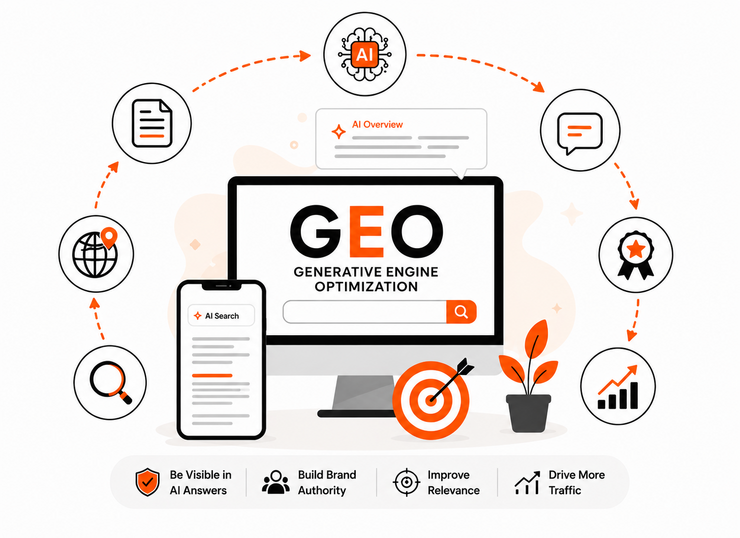
Generative Engine Optimisation (GEO) refers to the process of improving a brand’s online visibility across AI-powered search experiences and generative search features.
Unlike traditional SEO, where the primary objective is to improve rankings for specific search queries, GEO focuses on making content useful and understandable for AI systems that generate answers from multiple sources.
Google’s current guidance makes an important point: traditional SEO fundamentals remain relevant for AI search. Google AI Overviews and AI Mode rely on Search systems to discover and retrieve relevant information, meaning strong technical SEO, helpful content, crawlability, and website quality continue to matter.
“The future of search is not just about being found. It is about being understood, trusted, and referenced.”
GEO vs Traditional SEO
GEO does not replace SEO. Instead, it expands the way brands should think about search visibility.
| Traditional SEO | GEO |
| Focuses on search engine rankings | Focuses on visibility in AI-generated answers |
| Targets keywords and search queries | Targets topics, entities, questions, and user intent |
| Optimises pages for search engines | Makes information clear and useful for AI systems |
| Focuses heavily on SERP positions | Focuses on being considered as a reliable source |
| Measures rankings, clicks and organic traffic | Also considers visibility within AI search experiences |
For businesses investing in digital marketing services Ahmedabad, this means the strategy should increasingly combine traditional search optimisation with content that answers real customer questions clearly and comprehensively.
Why Is GEO Becoming Important for Brands?
AI-powered search is changing how people discover information. Instead of searching several websites individually, users can ask conversational questions and receive a summarised response.
For example, a potential customer may search:
“Which digital marketing company in Ahmedabad is suitable for a small business?”
An AI-powered search experience may analyse information from different websites before presenting recommendations or supporting links.
This creates another visibility opportunity for businesses. A company may not only want its website to rank for “digital marketing company in Ahmedabad”; it may also want its expertise, services, reviews, and useful content to be discoverable across the wider web.
How Can Brands Improve Their GEO Strategy?
1. Create Helpful, Original Content
Content should solve genuine customer problems instead of simply repeating information already available online. Google recommends creating unique, valuable, reliable, people-first content rather than producing large volumes of generic pages.
Brands should publish detailed guides, comparisons, FAQs, case studies, industry insights, and practical resources that demonstrate genuine expertise.
2. Answer Questions Clearly
AI search often works around questions and conversational queries. Content should therefore provide direct answers before expanding into supporting details.
For example, instead of only targeting “SEO services in Ahmedabad”, a brand can create content answering:
- What does an SEO service include?
- How long does SEO take?
- How does local SEO help businesses?
- What should businesses check before hiring an SEO agency?
This makes the content more useful for both people and modern search experiences.
3. Strengthen Brand Authority
AI systems can consider information from multiple sources. Brands should therefore build a consistent and credible presence across their website and relevant external platforms.
Author information, business details, genuine customer experiences, industry contributions, case studies, and expert insights can help demonstrate credibility.
4. Maintain Strong Technical SEO
GEO is not a reason to ignore technical SEO. Google states that pages need to be crawlable, indexable, and eligible to appear in normal Search before they can be considered for AI search features.
Businesses should therefore continue focusing on:
- Website speed and page experience
- Mobile usability
- Internal linking
- Crawlability
- Clear website structure
- Indexation
- Structured data where appropriate
- High-quality textual content
5. Optimise for Meaning, Not Keyword Stuffing
Modern search systems can understand related terms, concepts, and context. Brands do not need to force the same keyword repeatedly into every paragraph.
For example, a digital marketing consultant in Ahmedabad can naturally discuss SEO, paid advertising, social media marketing, content marketing, conversion optimisation, and analytics within a comprehensive guide.
The objective should be to cover the topic meaningfully rather than manipulate keyword frequency.
SEO and GEO Should Work Together
A strong strategy combines traditional SEO with GEO principles.
| SEO + GEO Area | What Brands Should Focus On |
| Content | Original, useful and expert-led information |
| Keywords | Search intent and relevant topic coverage |
| Technical SEO | Crawlability, indexation and website performance |
| Authority | Expertise, trust and consistent brand information |
| User Experience | Clear navigation and easy-to-understand content |
| Measurement | Organic traffic, conversions and AI search visibility |
For businesses looking for a digital marketing company in India, this combined approach can help build long-term visibility instead of relying on one search platform or one ranking method.
Did You Know?
Google introduced dedicated Search Console reporting for generative AI visibility in June 2026. The new reporting provides dedicated views for visibility within generative AI features such as AI Overviews and AI Mode, although the rollout is currently limited to a subset of websites.
This highlights an important change: measuring search performance is gradually expanding beyond traditional ranking positions and organic clicks.
Are Your Marketing Efforts Falling Short? How Can Our Agency Supercharge Your Performance?
Maximize your marketing ROI with our integrated Conversion Optimization solutions tailored for Performance Marketing campaigns.
Is GEO the Future of Search Marketing?
GEO is becoming an important part of the conversation around search visibility, but businesses should not treat it as a replacement for SEO. Google’s own guidance states that existing SEO best practices continue to be relevant for generative AI search.
For brands, the practical approach is simple: create genuinely useful content, maintain a technically strong website, demonstrate expertise, answer customer questions, and build a trustworthy digital presence.
A professional digital marketing company in Ahmedabad can help businesses integrate these principles into their broader SEO and content strategy. As AI-powered search continues to evolve, brands that focus on being genuinely useful and authoritative will be better positioned to remain visible across changing search experiences.
Conclusion
GEO is changing how brands approach online visibility by expanding the focus from traditional search rankings to visibility within AI-generated answers. However, GEO does not replace SEO. Businesses still need technically strong websites, helpful content, relevant keywords, strong authority, and a positive user experience.
As AI-powered search continues to evolve, brands that consistently provide accurate, useful, trustworthy, and well-structured information can improve their chances of being discovered and referenced in AI search results. Combining SEO with GEO can therefore help businesses build a stronger and more future-ready digital presence.